
Of the 39 researchers who have won the Avenir Award within the decade of its existence, Susan Shen, MD, PhD, assistant professor of psychiatry in the University of Iowa Carver College of Medicine, is the first female psychiatrist, the first from Iowa, and only the third psychiatrist overall to receive the highly-competitive grant.
“I wanted to represent the field, which is really what motivated me to apply,” Shen says.
The $2.3 million grant, which includes $1.5 million in direct funds, will be distributed to Shen’s lab in annual installments of $300,000 over the next five years. It will fund her lab’s research into the shared genetic underpinnings of substance use and psychiatric disorders.
The grant is administered through the National Institute on Drug Abuse (NIDA), one of the National Institutes of Health (NIH). Officially named the Avenir Award in Genetics and Epigenetics of Substance Use, it is only awarded to about three recipients per year.
The purpose of the Avenir award is to kickstart innovative research by “early-stage” investigators in three focus areas pertaining to HIV/AIDS, the genetics and epigenetics of substance use, or the chemistry and pharmacology of substance use.
A fresh perspective on substance use and psychiatric disorders
Avenir award recipients are rarely physicians or psychiatrists, let alone psychiatrists who specialize in molecular genetics and cellular studies, like Shen.
“So, I did bring a different, naïve, fresh perspective,” she says.
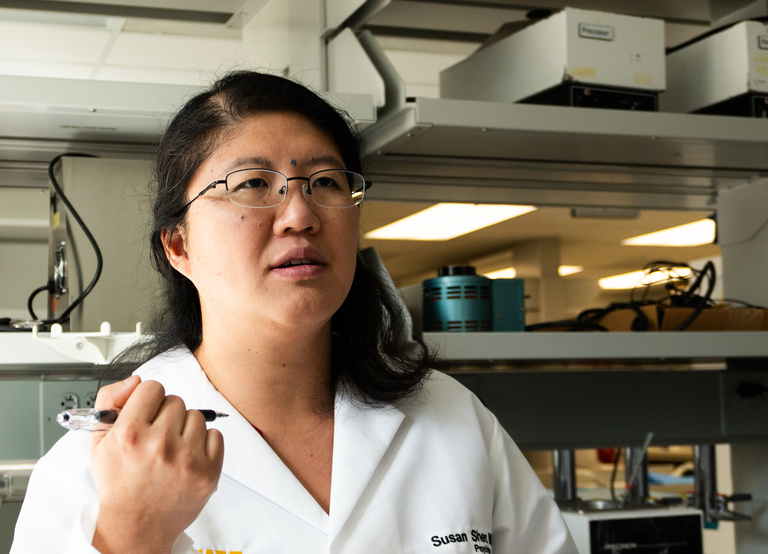
Shen’s winning proposal focuses on investigating the genetic co-occurrence of substance use and psychiatric disorders. Roughly half of all people diagnosed with a substance use disorder are also diagnosed with a psychiatric disorder and vice versa. Yet there has been very little research into this intersection.
Furthermore, there is a lack of FDA-approved medicines that specifically target both substance use disorders and psychiatric disorders at the same time.
Viewing it as an opportunity to be bold and creative, Shen said she approached the topic as an outsider.
“We treat substance use and psychiatric disorders like they’re separate entities,” she says. “I think this is a big gap in our society.”
Shen and her team aim to bridge this gap by identifying cellular biomarkers that correspond to substance use and psychiatric disorders. In doing so, they hope to create a genetic roadmap that could lead to novel treatments for both conditions.
“That’s the hypothesis,” she says with a smile.
Success in an approachable atmosphere
In addition to a written proposal, Shen delivered a 15-minute oral presentation to a committee of experts, including past recipients of the Avenir Award. To prepare, she sought feedback from colleagues and mentors, including those within the Carver College of Medicine, as well as her former mentors (postdoc co-advisers Steven Altschuler and Lani Wu at the University of California San Francisco and PhD adviser Joseph Corbo at Washington University in St. Louis).
Shen gives a special shoutout to her fellow researcher Jacob Michaelson, PhD, the Roy J. Carver Professor of Psychiatry and Neuroscience, who diligently attended every one of her practice talks.
With a laugh, Shen said, “I don’t know if I’ve worked as hard on any single thing as that talk. It was $1.5 million for a 15-minute talk. So, it was sort of like $100,000 per minute.”
Shen alsomcredits her success to support she received from the Iowa Neuroscience Institute and the Department of Psychiatry, from her senior faculty mentors like Michaelson; vice chair for research John Wemmie, MD, PhD; and department chair Peggy Nopoulos, MD, to administrative staff Tina Cronbaugh, Carla Nishimura, and Katie Zear, who helped her prepare all the grant materials.
“I’m very grateful that I’m here at the University of Iowa because I think that the collegiate atmosphere made it much more feasible for me,” Shen says. “I feel comfortable approaching people, even people whom I didn’t know. I think all of those pieces were necessary.”